

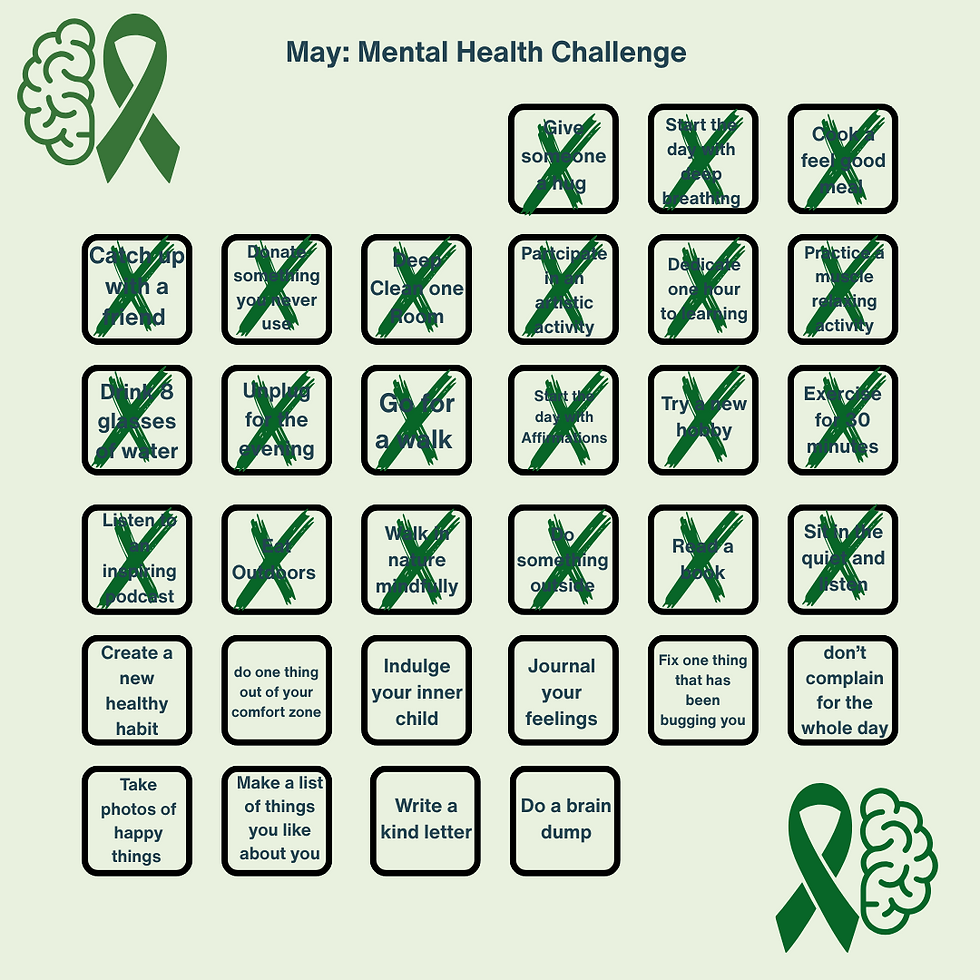
Day 22 – Exercise for 30 Minutes: Moving My Body, Moving My Mind
- May 21, 2025
- 3 min read
Let’s talk about something most of us love to hate: exercise.
Now before you roll your eyes or click away, let me be honest—this one wasn’t easy for me either. I have all the excuses. No, really. I could give a TED Talk on why I don’t exercise regularly. My personal favorite? “I don’t like to exercise in front of people.” Not strangers at a gym. I mean people I know. Like my spouse. Who is always home. And always—bless him—wants to talk to me.
It’s silly, I know. Ridiculous, even. I could just ask for 30 minutes of privacy. Or, as I finally decided to do, wait until he takes his afternoon nap and quietly sneak in a workout while he’s passed out cold and not likely to witness me flailing through squats.
So yes, I did the thing.
I typed “exercise for women over 40” into YouTube and found the wonderful Fabulous50s. I started with a 10-minute stretch (because I haven’t moved my body properly in... well, let’s not count). Then I did the 15-minute Anti-Aging HIIT workout, followed by a calming 5-minute cool-down stretch. Let me tell you, everything aches today. But it’s that satisfying ache—the kind that tells you your body did something good.
While I was stretching, sweating, and wondering why I’m so weird about exercising around people I love, I also had another realization: this actually feels good. Not just physically, but mentally.
The Science: Why Exercise Is a Game-Changer for Mental Health
If you’ve ever felt better after a walk, dance party, or full-body meltdown in yoga pants—congrats, you’ve already experienced the mind-body connection.
Scientific research backs this up:
Endorphins: Exercise increases the production of endorphins—our body’s natural mood elevators. They're like happy little brain hugs.
Reduced stress: Physical activity helps reduce levels of cortisol (the stress hormone), giving your overworked brain a chance to breathe.
Improved sleep: Regular movement improves sleep quality, which plays a massive role in emotional regulation and energy levels.
Sharper thinking: Exercise promotes neurogenesis (growth of new brain cells), particularly in areas related to memory and learning. Translation: you’re not just getting stronger—you’re getting sharper.
Resilience against depression and anxiety: According to the Harvard T.H. Chan School of Public Health, running for 15 minutes a day or walking for an hour reduces the risk of major depression by 26%. And if you're already struggling with depression, exercise can help reduce symptoms just as effectively as antidepressant medication—for some people.
In short, your brain loves when you move your body.
My Personal Takeaway
There were moments during that workout where I was out of breath, red-faced, and convinced my muscles were plotting revenge. But when it was over, I felt... proud. Not just for doing it, but for not giving up. And here’s the kicker: I felt lighter mentally. Not “I just had a spiritual breakthrough” light, but the kind where you exhale and realize something in your brain feels a little less tense. A little more settled.
I think that’s what exercise can do. It doesn’t need to be perfect or Instagram-worthy. It just needs to happen. Even once. Even imperfectly.
Where I Go from Here
Let’s be clear—I’m not suddenly becoming a fitness influencer. I won’t be doing daily workouts with matching sets of activewear and a water bottle the size of a toddler. But I can commit to once a week to start. Just that. And if that goes well, maybe I’ll do more.
Because here’s what I’ve learned: doing something for my body also helps my mind. And right now, in the middle of this healing journey, I need both.
I hope if you’re reading this and exercise feels impossible, overwhelming, or like something other people do—you’ll remember this post. Start tiny. Stretch in your living room. Walk around the block. Dance to one song in your kitchen.
Your brain will thank you. Your heart will thank you. And hey—your legs might scream a little—but they’ll thank you later too.



Comments